
A Practical Guide to Intelligent Document Processing (IDP)
Author: Tom Campbell
21 August, 2026
Turning Documents into Usable Data
Every business has important information trapped in documents. It may arrive as an email attachment, invoice, claim form, contract, application, or scanned report. In many organizations, an employee still opens each item, finds the needed details, and types them into another system.
That creates three predictable costs: labor, delay, and errors. Traditional automation can reduce the work, but it usually depends on consistent layouts and wording. Regular expressions work when labels do not change. Fixed-coordinate extraction works when every page looks the same. OCR turns scanned images into text, but it still needs rules to decide what the text means. These methods remain useful for stable forms, but they struggle when document formats and language vary.
Intelligent document processing, or IDP, is designed for that variability. Think of it as a digital intake team: it collects documents, identifies what they are, finds the important information, and turns it into structured data that business systems can use.
How the Pipeline Works
A practical IDP platform uses six stages: ingest, classify, parse, chunk and embed, retrieve, and extract.
Ingest. Documents arrive from Outlook, Gmail, file drops, APIs, or custom systems. Each item is normalized into a common data shape so the rest of the pipeline can process it the same way, regardless of source.
Classify. The platform determines the document type and where it should go. Rules, machine-learning models, large language models, or a combination can be used. Once the type is known, the platform applies the correct field definitions and processing settings.
Parse, chunk, and embed. The platform pulls out the document’s text and useful structure, divides the content into smaller sections, and converts each section into a vector representation. This lets the platform search by meaning, not just exact keywords.
Retrieve. The platform finds the best evidence for each field. An insurance policy, for example, may contain several email addresses. When the platform needs the insured’s primary email, it searches using the field name, definition, synonyms, and expected format. This retrieval-augmented generation, or RAG, step sends the model only the few passages most likely to contain the right answer, along with source, page, and document metadata.
Extract. The model returns the specific value in a structured format, such as JSON. This targeted approach is more efficient than sending a 50-page document to an LLM and hoping it selects the correct section. It reduces processing cost and irrelevant noise while producing more repeatable results.
A Platform, not just an AI Prompt
In practice, production IDP is less about a single prompt and more about data engineering, controls, and operations. The model is only one component. The larger platform includes source connectors, configuration, logging, document status, checkpointing, a review application, monitoring, and connections to downstream systems.
Separating the pipeline into stages also matters. Each stage can scale independently, and a failure does not need to restart the entire process. Checkpoints allow processing to resume from the last successful step. Logging records what happened and where each extracted value came from, while monitoring tracks accuracy by field, source, and document type. Versioned configurations show what changed between runs.
A configuration-driven design creates long-term value. Adding a new document type should usually mean defining its fields, rules, and retrieval settings, not building a new application from scratch.
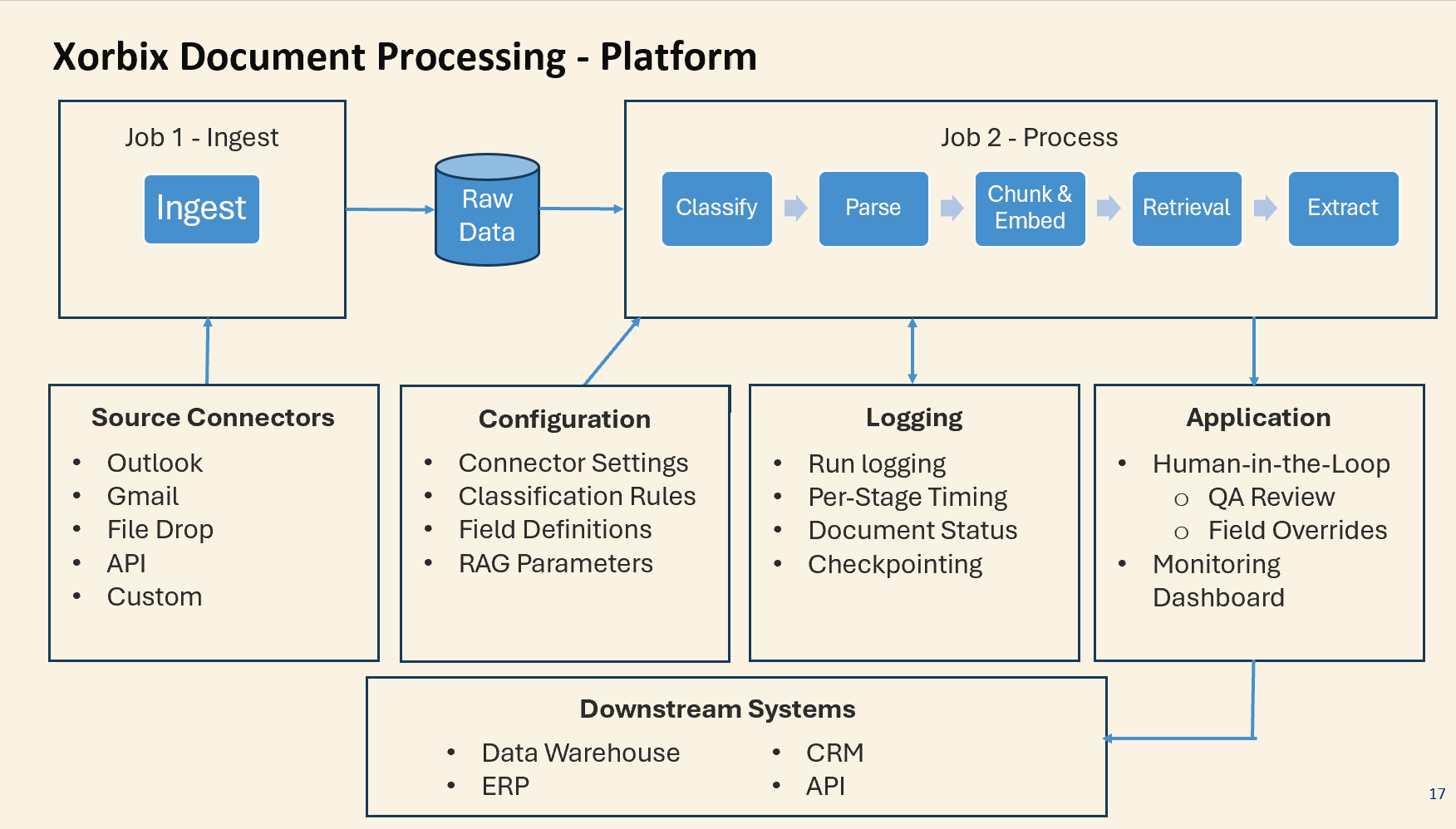
The Xorbix IDP platform separates document intake, processing, review, monitoring, and downstream integration.
Why People Remain part of the Process
A well-designed IDP platform does not ask your business to trust AI blindly. It shows the extracted values and the evidence behind them so a reviewer can confirm, correct, or reject the result. Users can also change an incorrect document type and send it through the right processing path.
Not every document requires the same level of review. Clear rule-based results may pass automatically, while missing fields, low-confidence values, or unusual documents can be routed to a person. The goal is simple: let software handle repetitive reading and typing while people handle exceptions and decisions.
The Business Value
Approved data can move directly into a CRM, ERP, data warehouse, claims platform, or API without being re-keyed.
| Less data entry | Faster turnaround | Fewer errors | Clear audit trail |
The larger benefit appears over time. Once intake, processing, review, monitoring, and integration are in place, each new document type becomes an addition to the platform rather than a separate project.
Where to Start
Start with a high-volume workflow where employees spend significant time reading documents and copying information. Claims, invoices, purchase orders, applications, contracts, and customer-service emails are strong candidates.
| 1 | Choose one workflow with clear volume and business pain. |
| 2 | Measure current processing time, errors, and exception rates. |
| 3 | Improve the configuration using real review feedback. |
IDP does not replace business judgment. It gives employees faster access to trusted information so they can spend less time moving data and more time using it.